


Nurse Case Management
Our nurses are ready to help.
PDI’s case management philosophy focuses on the management and coordination of care through efficient use of resources. Cost containment, while essential, is not the only goal. Quality and continuity of care, coupled with the assurance of appropriate and timely intervention, are crucial elements for recovery and promoting a stay-at-work/return-to-work philosophy.
Current NLC States and Status
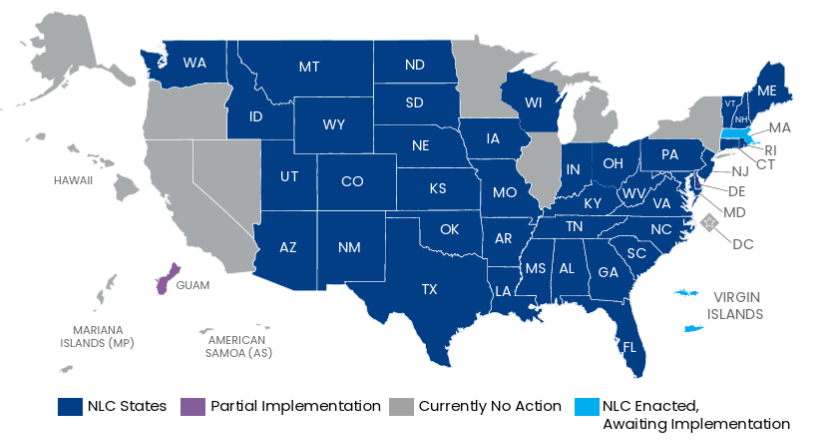
The Nurse Licensure Compact (NLC) allows nurses to have one license to practice in multiple states. There are currently 43 jurisdictions that have enacted NLC legislation, meaning they recognize the multi-state license or have such legislation pending.
Telephonic Case Management
PDI Case Managers are liaisons between the injured worker, employer, claim representative, healthcare providers and often attorneys. Focus is on facilitating a return to work by expediting medical treatment, decreasing fragmentation and accomplishing the referral objective.
Field Case (on-site) Management
Provides an in-person evaluation of the injured worker, provider and/or job site while coordinating care and services to promote recovery and return to work. This service is best utilized as a task-based assignment.
Catastrophic Case Management
Establishes a customized and comprehensive care plan to assist the injured worker, family, employer, and claims professional in achieving the optimal outcome for long-term care and financial exposure when an injury results in potential life-altering complications.
A nurse case manager plays a crucial role in workers’ compensation.
-
A nurse case manager acts as an advocate for the injured worker, ensuring they receive appropriate and timely medical care. They work closely with healthcare providers to coordinate treatment plans, monitor progress, and address any concerns or complications that may arise.
-
A nurse case manager collaborates with medical professionals to develop and implement comprehensive treatment plans tailored to the specific needs of the injured worker. They facilitate communication between all parties involved, ensuring consistency and continuity of care.
-
By engaging early in the workers' compensation process, a nurse case manager can help identify potential barriers to recovery and intervene proactively. They assess the injured worker's needs, address immediate medical concerns, and implement strategies to prevent complications or delays in treatment.
-
One of the key responsibilities of a nurse case manager is to identify appropriate and cost-effective medical services. They ensure that the treatment provided aligns with evidence-based guidelines, avoid unnecessary tests or procedures, and help contain medical costs associated with the claim.
-
Nurse case managers collaborate with employers, healthcare providers, and injured workers to develop return-to-work plans. They assess the injured worker's functional abilities, coordinate accommodations, and facilitate a smooth transition back to work, promoting successful and timely return-to-work outcomes.
-
Nurse case managers serve as a bridge between the injured worker, employer, healthcare providers, and insurance carriers. They facilitate clear and effective communication, ensuring everyone is informed about the injured worker's progress, treatment plan, and any modifications or concerns. They also educate the injured worker about their rights, treatment options, and self-care strategies.
-
In addition to addressing physical health concerns, nurse case managers also recognize and address the psychosocial aspects of an injured worker's recovery. They provide emotional support, help manage stress, and connect the injured worker with appropriate resources for mental health or counseling if needed.
-
Nurse case managers contribute to the overall claims management process by providing detailed documentation, collecting medical records, and ensuring compliance with regulatory requirements. Their involvement helps facilitate accurate and timely claims.
-
By providing medical expertise, care coordination, and support, nurse case managers contribute to the overall well-being of injured workers. Their involvement helps optimize medical outcomes, promote timely recovery, and facilitate a smooth and efficient workers' compensation process.

I am currently handling a case involving a truck driver who experienced a rollover accident resulting in a fractured left humerus. The driver sought immediate medical attention and underwent surgery. I originally received the case as a TCM (Telephonic Case Manager). During my conversation with the injured worker (IW), I learned that he had been experiencing pain and limited range of motion for over a year. Recognizing the need for further intervention, a second operation was deemed necessary. The IW's initial surgeon, who specialized in trauma, seemed to overlook his complaints, and the IW's physical therapy was not yielding progress.
Upon obtaining the CT scan report of the humerus conducted, it was discovered that the IW had a non-union and broken screws. Both the nurse case manager (NCM) and the IW discussed the need for a second operation due to the IW's lack of improvement and high pain level. Additionally, the IW is a smoker, which may have contributed to the non-union. The IW consulted a shoulder specialist, who recommended seeking the expertise of another trauma surgeon. This new surgeon reviewed the CT scan and determined that the plate used during the initial surgery was too large, resulting in broken screws and a non-union.
A revision surgery was performed, and physical therapy commenced. At the start of therapy, the IW's range of motion (ROM) for forward flexion was 90 degrees, accompanied by a pain level of 7/10. After just one week of therapy, the ROM improved to 130 degrees for forward flexion, and the pain level reduced to 2-3/10. Although the IW experiences higher pain levels on some days after therapy, he no longer requires narcotics and only occasionally uses Tylenol and Aleve for pain relief.
The IW is extremely satisfied with the outcome of the case, expressing contentment with the doctor and the NCM's support throughout the process.
SENIOR NURSE CASE MANAGER, PDI